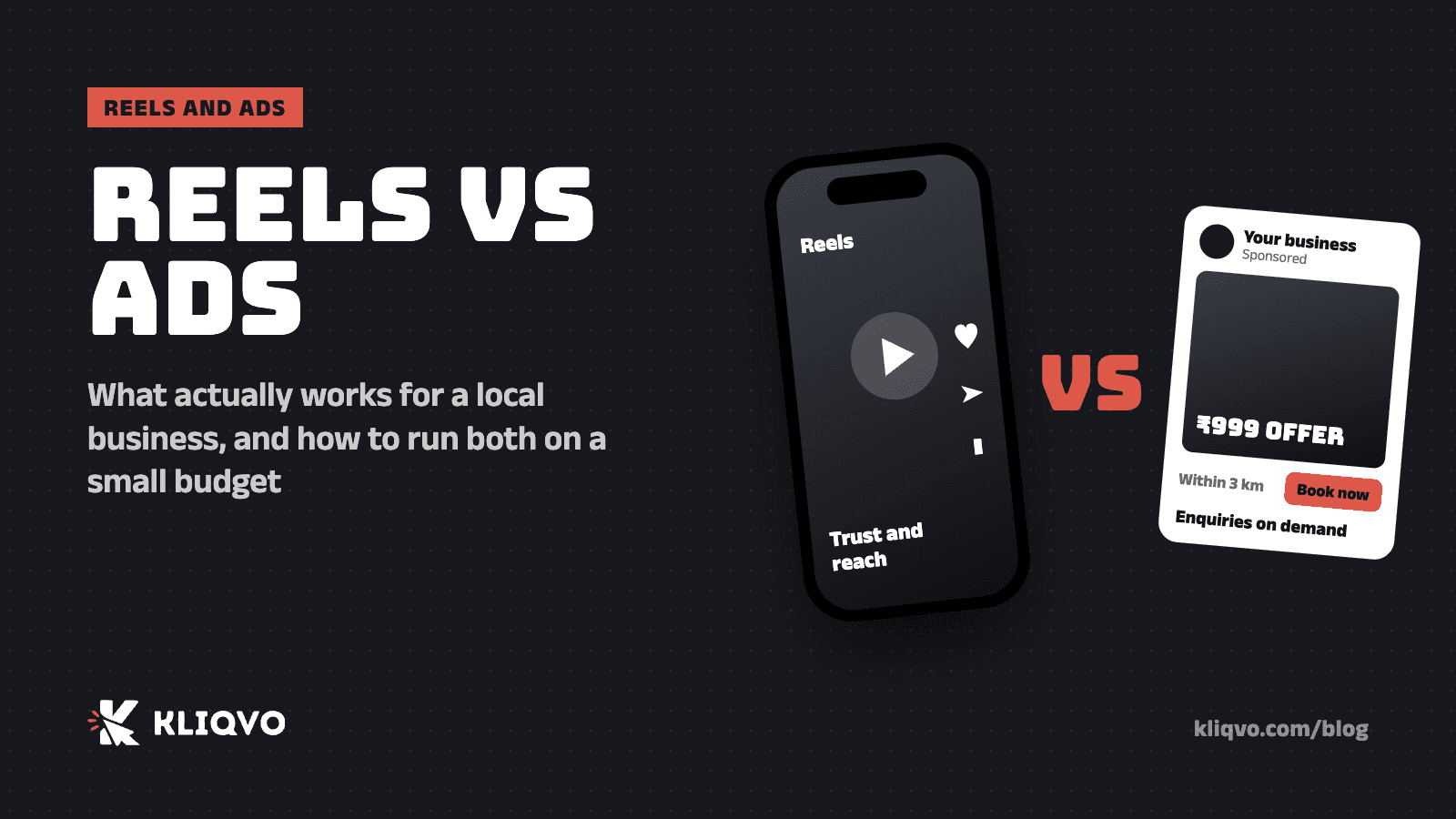
Short answer: use both, in that order. Reels make people notice and trust you. Ads put your offer in front of the right people nearby and turn that trust into enquiries. A local business that only posts reels gets views but few calls. One that only runs ads pays more for every enquiry, because nobody recognises the name.
The rest of this article explains when each one wins, and how to split a small budget between them.
What reels are good at
Reels are the cheapest reach on Instagram and Facebook right now. A good reel can travel far beyond your followers without a rupee of ad spend.
One reel we made for Pawfex Multispeciality Pet Hospital reached 1.1 million people, with 121K likes, 10.8K shares and 3.5K saves. That is the upside of reels: when people share them, the platform does the distribution for you.
Reels work best for:
- Trust. People see your space, your team and your work before they ever call.
- Being remembered. A familiar face or a running format makes your name stick.
- Material for ads. Your best organic reel is usually your best ad.
What reels are bad at: predictability. You cannot choose who sees an organic reel, or when. A reel with a million views may reach almost nobody within 5 km of your business.
What ads are good at
Meta ads (Instagram and Facebook) and Google ads let you choose exactly who sees your offer: people within a few kilometres, of a certain age, at a certain time.
Ads work best for:
- Enquiries on demand. You can switch them on before a festival, a launch or a slow month.
- Local targeting. Only people who can actually visit you see the ad.
- Measuring cost. You know what each enquiry cost, so you know what is worth repeating.
What ads are bad at: trust on their own. An ad from a page with no recent posts, or no faces, gets scrolled past. You end up paying more for every lead.
When to lean on reels, when to lean on ads
| Your situation | Lean on |
|---|---|
| New business, nobody knows you | Reels first, small ads. Build a reason to trust you before paying for clicks. |
| You need bookings this month | Ads. Reels are too slow and unpredictable for a deadline. |
| Festival, sale or launch | Both. Reels for buzz, ads to reach people nearby. |
| Lots of followers, few enquiries | Ads. Turn attention into calls with a clear offer. |
| Ads are getting expensive | Reels. Fresh, trusted creative brings the cost per lead back down. |
How to run both on a small budget
You do not need a big budget to do this properly. A simple rhythm that works for most local businesses:
- Make 8 to 12 reels a month in one shoot day. State your offer or price in the first two seconds.
- Watch which reels people save and share. Those are your best ideas.
- Turn the top one or two into ads shown only to people within a few kilometres.
- Send every enquiry to WhatsApp and reply within minutes. Speed of reply matters as much as the ad.
- Check the cost of each enquiry every week, and stop anything that is not working.
If you are not sure what your budget can bring, our ad budget calculator gives a typical range for your kind of business.
The mistake to avoid
The most common mistake we see is boosting random posts. Boosting spends money without a clear offer, a clear audience or a way to track who actually enquired. A proper ad campaign with one offer, a 3 to 5 km radius and a WhatsApp follow-up almost always does better with the same money.
Want us to look at yours?
We run both sides for businesses across Hyderabad and India: reels and content and Meta and Google ads. If you want a second opinion first, ask for a free Instagram audit and we will tell you which one your business needs more right now.